Home / For engineering leaders
How to tell whether AI on your team pays off
Your team already pays for AI agent licenses. The real question is what they do for the project. This page covers where the money goes, a calculator that runs on your numbers, and what you can see in the product today.
Where you lose money when agents don't know the project
- OnboardingUsually 2–3 weeks to set up the environment and learn the project, then another 2–3 weeks at half speed. On teams using AI Council, new developers pick up tasks on their first day.
- ReviewA pull request from an AI agent waits 17.6 hours for review to start, compared with 3.4 hours for a regular one. Reviewers don't trust the code until they've picked it apart.LinearB, Software Engineering Benchmarks 2026, 75th percentile. Source
- ReworkPRs written with AI get about 1.7 times more review comments than PRs written by people.CodeRabbit, State of AI vs Human Code Generation, December 2025. Source
- Senior developers' timeHalf of developers lose more than 10 hours a week to organizational friction. The biggest item is hunting for information about the project.Atlassian, State of Developer Experience 2025. Source
- People leavingWhen the person who knew a legacy module leaves, their decisions leave with them. Tasks in that code start getting pushed back.
What your team is losing right now
Answer a few questions about your project. Replace the sample values with your own and the numbers update right away.
And the question you can't put a number on
What happens to a legacy module if the only person who understands it leaves? People start working around the code, tasks in it get postponed, and when an urgent bug or vulnerability shows up, nobody can fix it quickly. AI Council keeps decisions and the reasons behind changes in a shared knowledge base tied to the code, so they stay with the team.
What you can see today
You can check what the agents do in the product instead of taking anyone's word for it. The system collects the numbers itself. Developers don't fill in anything.
| Where | What it shows |
|---|---|
| MCP Live › Sessions | Every agent session: which knowledge and rules it received, which tools it called and how long that took |
| MCP Live › Effectiveness | How often agents gather context, check the rules, edit code and record what they learned |
| MCP Live › Tool Stats | Which tools get used and which sit idle |
| Review | Branch status: Passed, Blocked with a list of issues, or outdated |
| Knowledge review | The knowledge audit log: what's outdated, what contradicts the code, what was replaced |
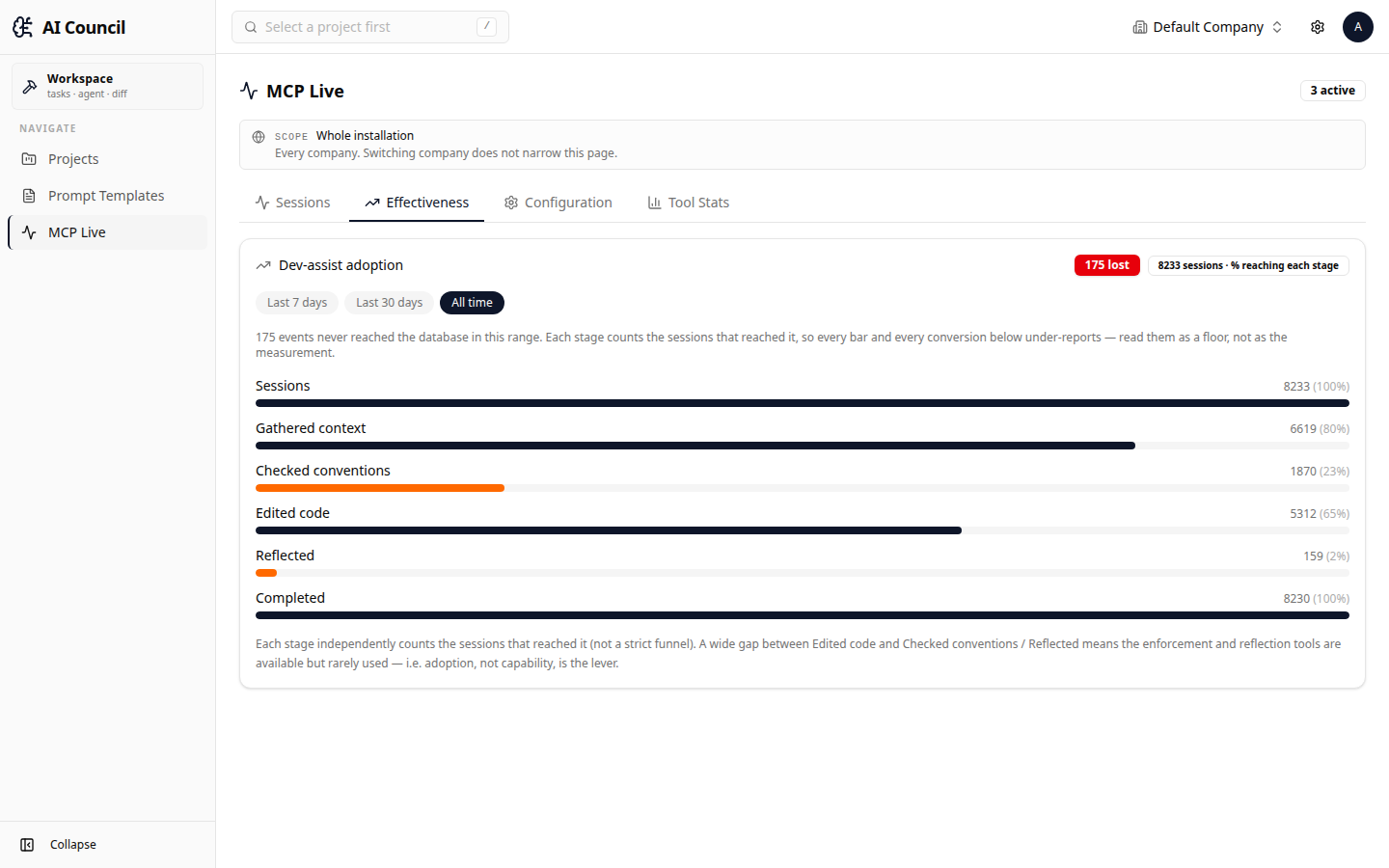
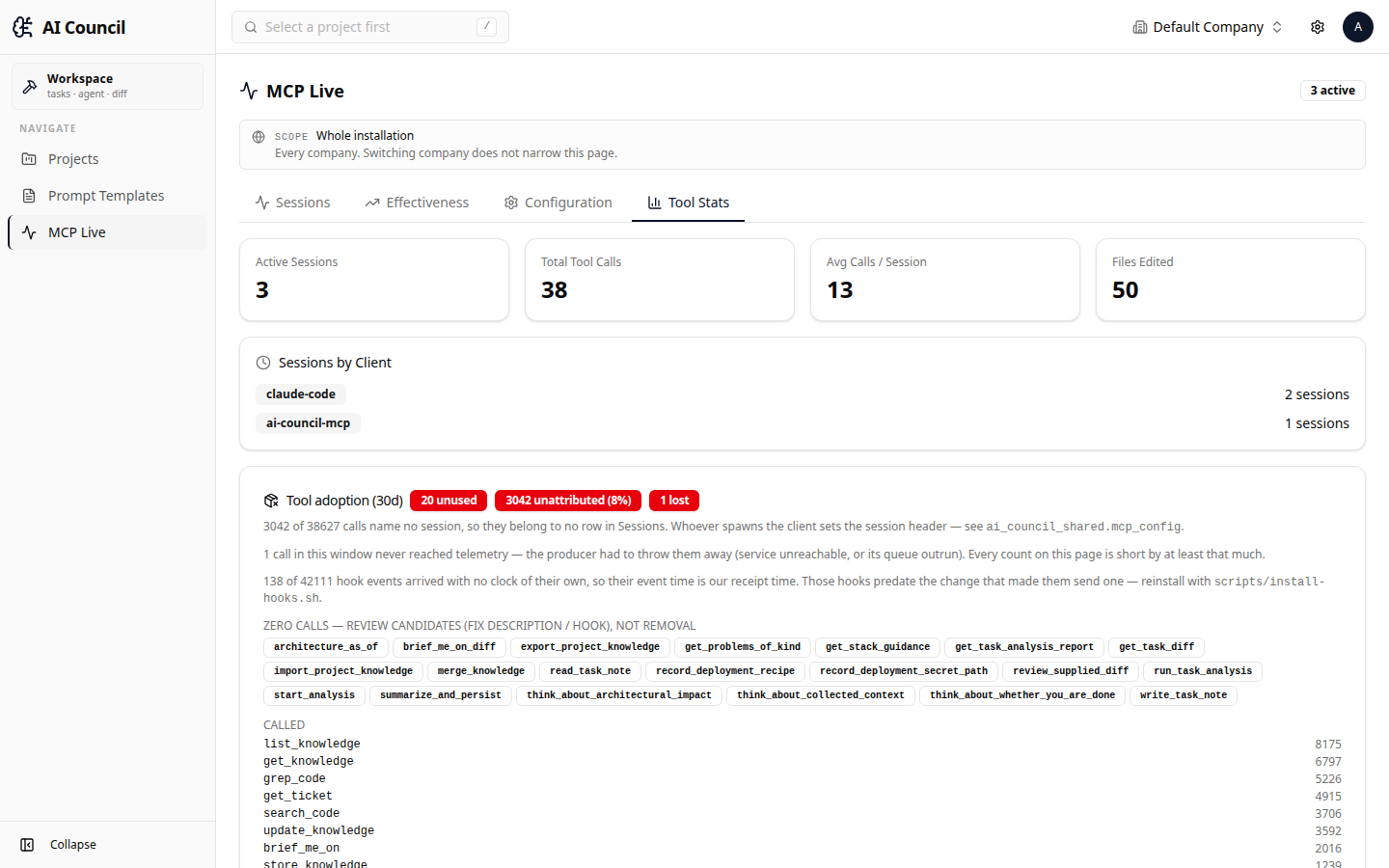
Why we don't go by how the team feels
- Perception and reality differIn a controlled METR experiment, experienced developers believed AI made them about 20% faster. Measured, they were slower.METR, 2025. Coverage of the study
- More code doesn't mean more tasks doneAcross 700+ companies, code output grew 30% after AI agents were introduced, while the number of closed tasks stayed statistically flat. Review took 49% longer.Harvard, "Artificial Intelligence in the Firm: Bottlenecks in Software Production", October 2026. Coverage
- The effect depends on contextGoogle's DORA research calls AI an amplifier: it delivers where agents can reach internal documentation and code. That access is what AI Council provides.Google DORA, 2025. Source
How to measure the effect in your first 4–6 weeks
Write down a few numbers before you connect AI Council. Then compare them with what you see a month or so later.
Week 0: record a baseline
Time to first merged MR for new hires, share of MRs sent back from review, hours a week spent fixing AI-written code, hours seniors spend answering the same questions.
Weeks 1–4: work as usual
Connect your repository and agents, in the cloud or on your own server. The team keeps working on real tasks. Nobody has to log anything by hand.
Weeks 4–6: compare
Put your baseline next to what AI Council records: agent sessions in MCP Live, branch review results, and the effect metrics. Then decide whether to keep going.
Questions from finance
How much does it cost?
$30 per user per month for teams of up to 10 people, $20 per user per month for teams of 10 to 50. For 50+ users or an air-gapped setup, we quote individually.
How is it billed?
A monthly subscription per user, billed in USD through Paddle. You pay online at checkout.
Where do I get invoices and receipts?
Paddle emails a receipt for every payment. Invoices and your billing history are available from Paddle's customer portal.
Who handles sales tax and VAT?
Paddle is the merchant of record. It calculates, collects and remits sales tax and VAT for your country, and the tax appears on your invoice.
What do we pay for separately?
LLM tokens. You pay the model provider directly with your own key. If you run an open-source model on your own servers, there's no token bill at all.
Can we connect only part of the team, or change the seat count later?
Yes. You pay per user, so add or remove seats whenever the team changes. Most teams start with one team on one project.
What if it doesn't pay off?
Cancel any time. The subscription stops at the end of the billing period, and there's no long-term commitment.
We need an Enterprise quote
Message us on Telegram (@DmitryLunevsky) or LinkedIn.
For software agencies and integrators
When a developer moves to a new project, you can barely bill the client for their first weeks. They spend that time reading code and asking colleagues. AI Council shortens it, and the project knowledge stays with your company even after the team on it changes.
See it on your own project
Connect your repository, record a baseline, and check the effect after 4–6 weeks.
